

Why the bottom goes first
Everything a door has to survive collects at its lowest edge. Rain that hits the door runs down it and stops at the bottom rail. Storm runoff crossing the slab stops there too. Slab moisture wicks up into whatever touches it. Grit, leaf litter and sand settle in the lowest part of the tracks. And on this patch there’s a standing extra: lake air, which carries enough moisture year-round to keep bare steel honest.
So steel rusts from the bottom up, rubber perishes at ground level first, and tracks bind where the grit sits. A tech who starts the inspection at eye level is reading the last chapter first.
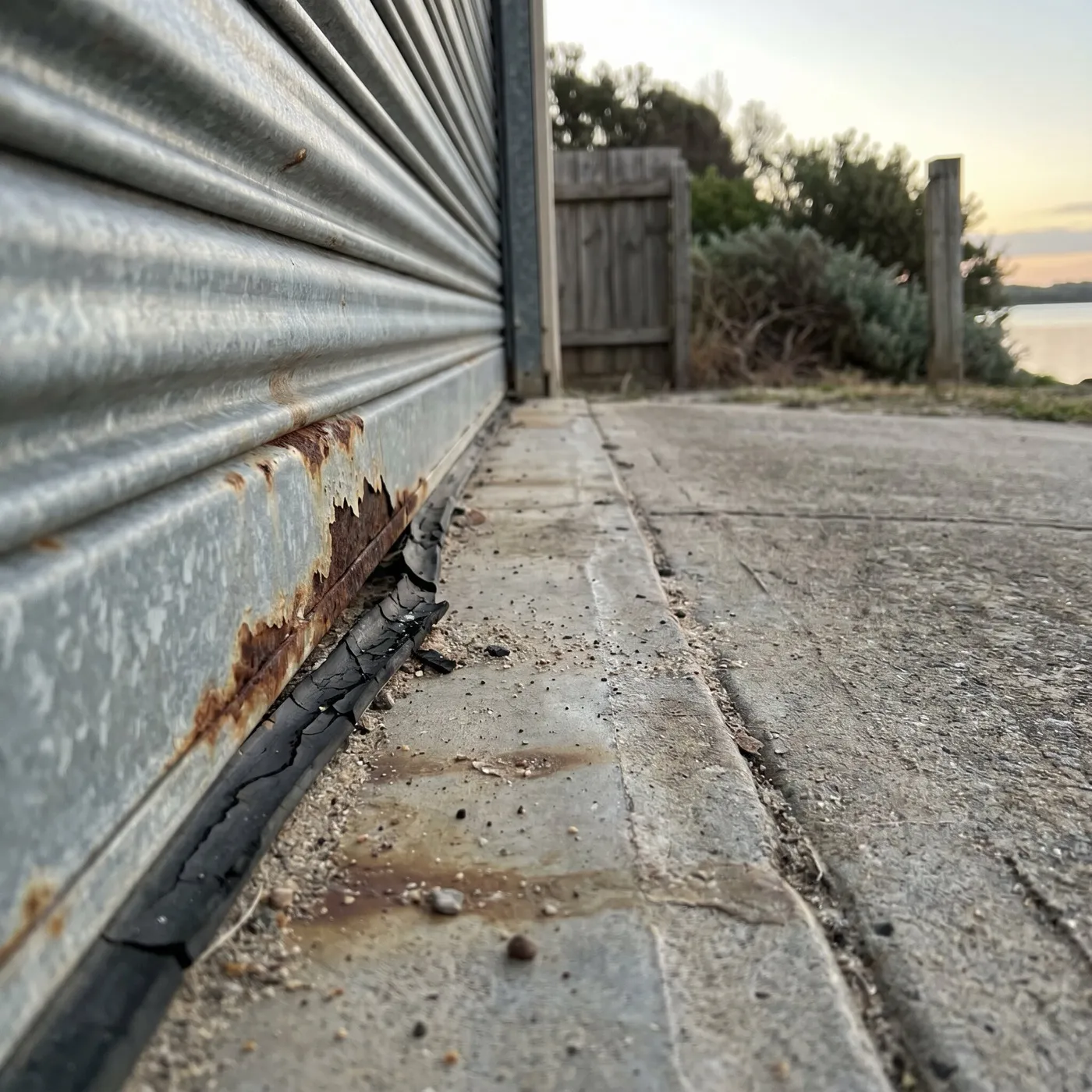
The four checks
1. The bottom rail
Look along the door’s bottom edge from a metre back. Even paint and clean galvanising is a good sign. A powdery white bloom, orange freckling or flaking paint along that edge means moisture has been sitting there. Surface rust is cosmetic for a while; the question is whether it has reached seams, fixings or the bottom brackets, and that’s a judgement call we’d rather make with our own eyes.
2. The bottom seal
The rubber strip under the door should sit plump against the slab. Cracked, flattened or lifting rubber has stopped doing its one job: keeping water, grit and draughts from getting under the door and at the rail. A perished seal is the cheapest thing on this list to put right, and replacing it early protects everything above it.
3. The track feet
The bottom few centimetres of each vertical track collect what the weather delivers. Grit and debris in the track feet is why a door starts to bind, grind, or wander off square in its run. If the track feet look like a beach, the rollers have been running through it.
4. The bottom brackets, cables and springs: look, never touch
At each bottom corner of the door, a bracket anchors the lift cables. Those cables run to springs that hold the door’s full weight under tension whether the door is up or down. Frayed cable strands, a bracket pulling at its fixings, or a visible gap in a spring’s coil are all findings worth a photo and a booking. They are never, in any circumstances, a DIY job. Product safety regulators class garage doors among the household items that injure people precisely because the stored energy is invisible; see the ACCC’s Product Safety Australia guidance on household safety. The bottom of the door is the waterline, and it’s also the danger line.
The line, exactly. Looking, photographing and gently testing the manual release: yours. Unbolting, winding, re-tensioning or unhooking anything connected to a spring or cable: ours. Nothing on the other side of that line costs less than a call-out.
What the lake adds
Warners Bay’s town flat sits on the North Creek catchment, and water has set its terms here for a long time: the flat flooded in 1949, in 1990, in the June 2007 east coast low, and again in April 2015. That’s not a scare line, and a garage door is not flood protection. The honest trade consequence is slower and duller: a flat that holds moisture, storm runoff that crosses slabs, and lake air on everything, which together mean the bottom-of-door read matters more here than it does two suburbs inland. Flood mapping and property-level flood information for the area is held by Lake Macquarie City Council; wear on the bottom of your door is held by the door, and it’s free to read.
On the rise it arrives differently: a steep driveway is a stormwater channel aimed at the bottom seal. In the town centre’s townhouses, the door works its wear on cycles instead, twice a day, every day, as the household’s real front door.
When the read says book
- Any fray, gap or movement at cables, springs or bottom brackets: book before using the door again.
- A door that’s become heavy, or an opener that strains: the balance has moved, and the motor is absorbing it for now.
- Rust that’s crossed from surface freckling into seams or fixings: worth a verdict while repair is still on the table.
- Seal perished or track feet gritted: a small service call now, a rail problem later.
If you want the two-minute version of this read with your own door’s answers, run the Waterline Read. If you’d rather we did it with our own eyes, that’s a booking: a service visit reads the whole door.
The words, level
- Bottom rail
- The horizontal bottom edge of the door curtain or panel: the first steel that water, grit and lake air reach, and the first place they leave a record.
- Bottom seal
- The rubber strip fixed under the bottom rail, sealing the door against the slab. Perishes years before the steel it protects.
- Track feet
- The lowest section of each vertical track, where debris settles and binding starts.
- Bottom brackets
- The fittings at the door’s bottom corners that anchor the lift cables. Under full spring tension at all times; never a DIY fixing.
- Torsion spring
- The wound spring on a shaft above the door that counterweights its mass. When one snaps it goes with a bang, and the door instantly becomes dead weight.
- Balance
- A balanced door, disconnected from its opener, stays put at half height. A door that falls or flies has a spring problem, not an opener problem.